An Ultimate Guide to Qasr Al-Hukm


Not every building is merely visited. Some seem to listen to you before you even look at them. In the heart of Riyadh, where different eras intersect and memory holds firm, Qasr Al-Hukm (Rule Palace), also known as the Government Palace, stands not as silent walls, but as an ancient narrator that witnessed the birth of a city, the rise of a state, and the passage of leaders and decisions that shaped a history still alive today. Here, politics was not just ink on paper, but steps taken in open courtyards, doors opened to citizens before delegations, and councils where the affairs of an entire nation were managed. Qasr Al-Hukm is not merely a historical landmark, but an ancient pulse that continues to beat at the heart of modern Riyadh.
About Qasr Al-Hukm and its Historical Significance
Qasr Al-Hukm was originally built to strengthen the fortifications of Riyadh during the campaigns of the First Saudi State. However, its true role became clearer during the era of the Second Saudi State, when Imam Turki bin Abdullah, may Allah have mercy on him, chose Riyadh as the capital of the state and made the palace the seat of governance and the administration of the country’s affairs. As the rule became more established, the palace was not merely the ruler’s residence, but a vibrant political center where state affairs were managed, delegations were received, and decisive decisions were made that shaped the features of that period.
The palace witnessed significant development during the reign of Imam Faisal bin Turki bin Abdullah, as its area was expanded, its fortifications were strengthened, and an upper passageway was added to connect it to Imam Turki bin Abdullah Mosque. This created a distinctive architectural scene that reflected the close relationship between religion and governance during that period. At the time, the palace also included a guesthouse, became a residential headquarters for the imams of the Second Saudi State, and served as an official venue for receiving delegations. It continued to play this role until the dawn of a new chapter in the Kingdom’s history.
When King Abdulaziz bin Abdulrahman Al Saud recaptured Riyadh in 1319 AH / 1902 CE, a new chapter began in the history of Qasr Al-Hukm. The King ordered that it be rebuilt on its former site, and construction was completed in 1330 AH / 1911 CE, turning it into the political heart of the emerging state.
King Abdulaziz used the palace as his residence and the seat of government for more than thirty years. At that time, it was the largest building in Riyadh, built from mudbrick and clay in the Najdi architectural style, and decorated with geometric motifs that reflected the spirit of local architecture.
Among the palace’s most notable features during that period were:
- Four main wings.
- Watchtowers.
- Official and public majlis halls.
- Supply storage rooms.
- A school for the King’s children.
- A library rich in manuscripts and rare books.
- Electricity was also introduced to the palace in 1350 AH / 1931 CE, a step that reflected the gradual transition toward modernity.
The Reconstruction and Modern Development of Qasr Al-Hukm
In 1376 AH / 1957 CE, under the supervision of the Custodian of the Two Holy Mosques King Salman bin Abdulaziz, may Allah protect him, during his tenure as Governor of Riyadh Region, a new phase of rebuilding Qasr Al-Hukm began. This led the palace to take on its modern architectural form, with its final development completed in 1412 AH / 1992 CE.
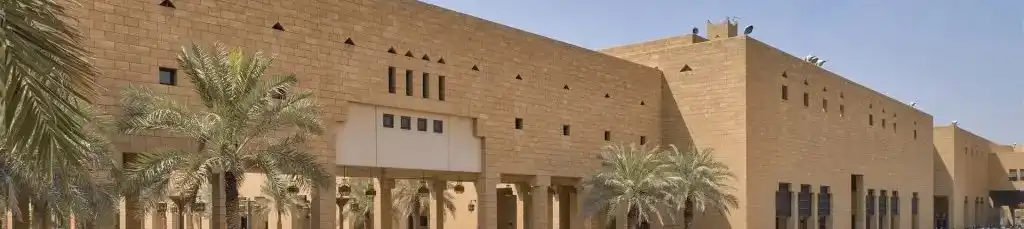
The palace was rebuilt on an area of 11,500 square meters, while preserving the traditional Najdi character with a modern architectural spirit that combines authenticity and functionality.
Parts of the Palace
The southern section: Consists of six floors designed in the form of a fortified castle, with four massive towers symbolizing strength and resilience, and a fifth central tower used for lighting and ventilation.
The northern section: Consists of five floors that connect smoothly with the rest of the building.
The exterior façades are almost solid and closed, while the interior embraces a series of courtyards and varied open spaces that create a sense of spaciousness and openness, striking a unique balance between a strong exterior and a comfortable interior.
Sections of Qasr Al-Hukm
The first floor of the palace includes:
- A grand royal majlis covering an area of 2,000 square meters and rising 14 meters high.
- Columns clad in marble.
- Authentic local decorations and inscriptions.
- The office of the Custodian of the Two Holy Mosques and adjoining majlis halls.
- The main dining hall covering 1,120 square meters.
- The office of His Highness the Governor of Riyadh Region and his private wing.
- The office of His Highness the Deputy Governor of Riyadh Region.
- Meeting rooms and official dining halls.
The upper floors include:
- Administrative offices.
- Meeting rooms.
- A lecture hall with a capacity of 185 people.
- Simultaneous interpretation systems and advanced audiovisual presentation facilities.
Today, the palace serves as the headquarters of the Riyadh Region Governorate and as a daily meeting place between citizens and the leadership.
Development of Qasr Al-Hukm
The development included:
- Restoring Al Masmak Fort and transforming it into a museum.
- Rebuilding Imam Turki bin Abdullah Mosque.
- Creating historic squares such as Al Safat Square and Al Adl Square.
- Developing traditional markets such as Souq Al Zal.
- Rehabilitating historic streets and gates.
Important Information for Visitors to Qasr Al-Hukm
- Follow the official visiting hours to avoid crowds and ensure an enjoyable tour.
- Wear appropriate and elegant clothing that respects the formal and historical character of the palace.
- Maintain calm and order inside the palace, and avoid tampering with any belongings or exhibits.
- Check the photography policy, as photography may be prohibited in some halls or around certain items.
- Follow all instructions and directional signs, and do not go beyond the areas permitted for visitors.
- Plan the visit in advance or make a reservation, if possible, to avoid crowds.
- Make use of tour guides to better understand the history, architecture, and heritage stories of the site.
- Carry water and comfort essentials if the visit is long or includes walking through the outdoor courtyards and gardens.
At the end of your journey inside Qasr Al-Hukm, you will realize that a visit to Riyadh is not complete without standing before this landmark, which brings together history, identity, and the dignity of place in one image. If you are planning to discover this heritage up close, begin your journey with confidence and comfort, and book your flight to Riyadh on WINGIE to benefit from our exclusive fares and offers. Let your journey to the heart of Saudi history begin from your seat in the sky!
You may also like:
- An Ultimate Guide to Riyadh Mall
- 10 Best Brunch / Breakfast Restaurants in Riyadh
- A Comprehensive Guide to Al Nakheel Mall in Riyadh
- A Comprehensive Guide to Hayat Mall in Riyadh
- Top 7 Malls in Riyadh
- Top 20 Family-Friendly Destinations in Riyadh
- Top 10 Restaurants in Riyadh
- Top 10 Attractions in Riyadh
- Al Nakheel Park and Top 6 Activities to Do
- Guide to Taibah Markets in Riyadh
- Guide to Riverwalk in Riyadh

